Have you been asked, “Where do you see yourself in five years?” only to realize you are not entirely sure of the answer? You are not alone.
As nursing professional development (NPD) practitioners, we are responsible for facilitating activities that foster professional growth and role competence across diverse practice settings, nursing specialties, and career stages. Standard 13 of the Nursing Professional Development: Scope and Standards of Practice (2022) emphasizes that we, too, have a professional responsibility to continuously enhance our own knowledge, skills, and competencies to support our ongoing development.
We invite you to follow our step-by-step approach, incorporating the nursing process in advancing your NPD role. As you read, we encourage you to reflect on your aspirations, define a clear vision for your future, and create a structured plan to shape your NPD career path with intention.
Step 1: Self-Assessment
Start evaluating your NPD practice by asking yourself, “Where am I now?” Professional self-reflection that includes both successes and “inquiry about problems in professional practice” provides a systematic process of critically thinking about professional situations and identifying gaps in knowledge or performance (Greenberger, 2020, p 459). This process serves as the foundation for professional growth, goal development, and continuous improvement within NPD practice.
Reflective journaling is an approach to self-assessment, consisting of narrative comments, pictures, flow charts, or other meaningful documentation. Using reflective journaling, the NPD practitioner documents thoughts and feelings from critical incidents as well as reflections on identified areas of improvement or learning needs (Zori, 2016). Journaling can be used as a strategy for thinking through experiences and lessons learned as part of self-assessment.
Another strategy is completing a professional SWOT (Strengths, Weaknesses, Opportunities, and Threats) analysis. You can perform this with reflective journaling to explore each section, as well as analyzing each section.
First, consider your strengths: What you have already accomplished and the knowledge, skills, and qualities that have assisted you. Remember to reflect upon any positive feedback others have provided.
Reflecting on weaknesses or areas for growth includes the areas you need to improve, interpersonally and professionally. What are the gaps in your knowledge, skills, or abilities in practice?
Opportunities are external factors that help you to reach your professional goals. Consider how you engage in lifelong learning and what opportunities are available. Opportunities might include organizational resources and networking with professional colleagues within and outside your organization. Joining a professional organization such as ANPD or an ANPD affiliate group provides networking, mentoring, and professional development opportunities.
Threats are external factors that could negatively affect your career development and impact your goal achievement. Examine aspects of your work environment that can cause challenges, such as time constraints, lack of resources, and role confusion. Consider what you can control and what you cannot. Then reflect and identify strategies to mitigate these factors so that you can achieve your goals.
Click here to view the Nursing Professional Development SWOT tool
Step 2: Create Your Vision
An important part of completing the SWOT is reviewing your results and visualizing what you want your professional future to be. Achievements might include obtaining NPD certification, advancing your degree, disseminating your work through publication or presentation, developing your leadership skills, or conducting NPD research, EBP, or quality initiatives. Reflect upon these questions:
- What do I dream about accomplishing in my career?
- Where do I see myself professionally in one year? In five years?
- Which opportunities can I visualize myself stepping into?
Step 3: Set Your Goals
Developing your vision leads to the next question, “How will I get there?” Setting clear, measurable goals ensures focused outcomes and participant accountability. These will assist in guiding your professional development and choosing activities that support achieving your goal.
By clearly identifying these gaps in the self-assessment step, NPD practitioners can prioritize areas of development. This gap analysis provides the foundation for developing meaningful SMART (Specific, Measurable, Achievable, Relevant, and Time-bound) goals that identify a focused area for growth, allowing individuals to target specific skills, experiences, or competencies that need improvement. SMART goals also establish measurable outcomes and realistic, attainable endpoints, ensuring that progress can be tracked effectively over time. Let us explore the development of a SMART goal together. In this example, my vision is to obtain NPD board certification. My SMART goal would be:
I will [S] achieve NPD board certification [M] by completing exam eligibility requirements and preparing with a study schedule of 3-5 hours per week [A] using available study materials, a certification preparation course, and practice tests in order to successfully pass the NPD-BC exam [T] by September 2026. Being NPD-board certified [R] supports career advancement, strengthens professional credibility, and aligns with my development goals.
Step 4: Make Your Plan
The next step is developing an action plan to guide goal achievement. An action plan identifies the specific tasks, timelines, strategies, and resources necessary to move from goal setting to implementation. It provides a clear framework that breaks larger professional aspirations into smaller, manageable steps, allowing individuals to remain focused and organized.
Action plans may also help individuals recognize available resources and support systems, including educational materials, mentorship opportunities, professional networks, and organizational tools that may assist in achieving the goal. Establishing a method for monitoring progress further promotes motivation and accountability while reducing feelings of stress or overwhelm associated with large professional goals (Harper, et al, 2023; Robinson et al., 2025).
An example of creating an action plan to meet the September 2026 certification SMART goal is:
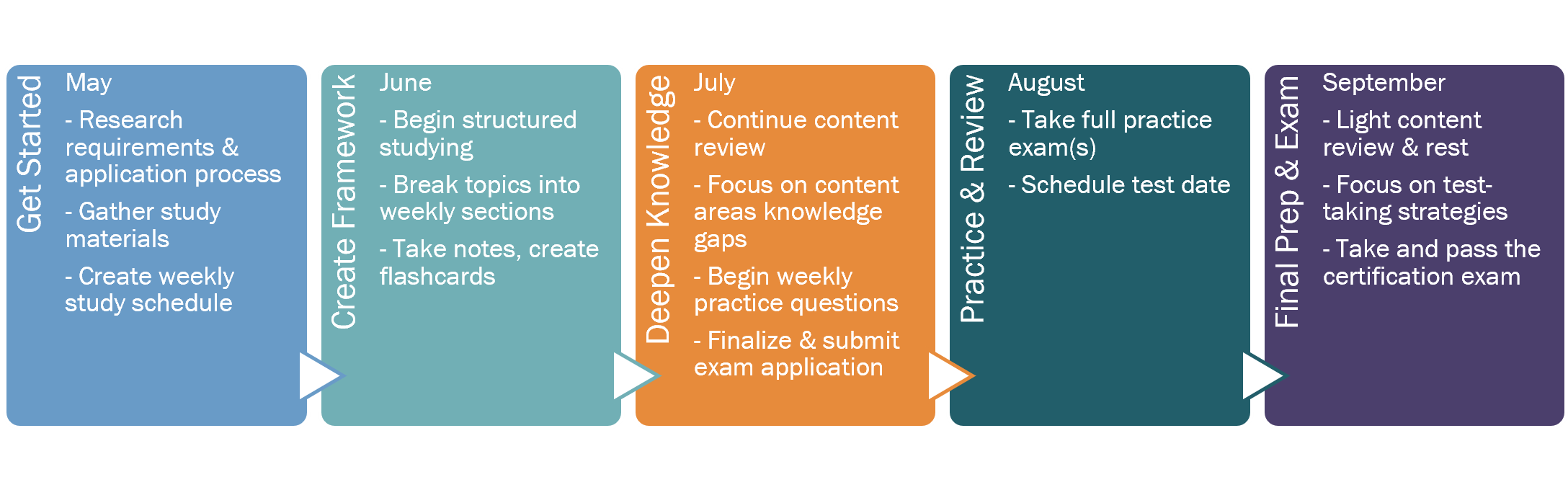
Click here to view an NPD Action Plan tool
Step 5: Implement Your Plan
This step focuses on implementing your action plan to achieve your SMART goal. It involves carrying out the identified tasks, activities, and strategies while following the established timeline. For our certification example, we would implement the steps discussed above (Harper, et al, 2023; Robinson et al., 2025).
Step 6: Evaluation
Evaluation is an essential component of professional development as it measures progress and determines the effectiveness of the action plan. Formative evaluation should be conducted throughout implementation to monitor ongoing progress, identify potential challenges early, and make adjustments as needed to increase the likelihood of achieving the SMART goal (Harper et al., 2023; Robinson et al., 2025).
At the completion of the plan, summative evaluation is used to determine whether the SMART goal was achieved. This final assessment provides an opportunity to reflect on accomplishments, identify strategies that were effective throughout the process, and understand areas for further development. If the goal was not fully achieved, summative evaluation can help guide recommendations for revising the action plan, adjusting timelines, or identifying additional resources and support needed for future success (Harper, et al, 2023; Robinson et al., 2025).
In the certification example, progress will be evaluated through weekly study tracking, practice questions and exam performance, and completion of established milestones within the action plan. Summative evaluation after the plan will determine achievement of NPD certification by September 2026 and identify opportunities for continued professional growth and future development.
Professional growth and career development require intentional reflection, strategic planning, and ongoing evaluation. Utilizing the nursing process as a systematic framework allows NPD practitioners to assess their current practice, identify professional strengths and areas for growth, and develop meaningful goals aligned with their future aspirations. As NPD practitioners continue to advance the nursing specialty, intentional goal setting and career planning remain essential for creating meaningful career paths that positively influence learners, healthcare teams, and organizations.
References
Harper, M. G. & Maloney, P. (Eds.). (2022). Nursing professional development: Scope and standards of practice (4th ed.). Association for Nursing Professional Development.
Harper, M. G., Robinson, J., Quinn, D., & Céramie, K. (2023). Role Development. In M. G. Harper (Ed.). Core Curriculum for Nursing Professional Development (6th ed.). Association for Nursing Professional Development.
Greenberger, S. W. (2020). Creating a guide for reflective practice: Applying Dewey’s reflective thinking to document faculty scholarly engagement. Reflective Practice, 21(4), 458–472. https://doi.org/10.1080/14623943.2020.1773422
Robinson, J., Holtschneider, M., & Smith, M., (2025). Nursing Professional Development Certification – It’s More Than Just Taking the Test, Journal for Nurses in Professional Development, 41(6), 319-324. https://doi.org/10.1097/NND.0000000000001170
Zori, S. (2016). Teaching critical thinking using reflective journaling in a nursing fellowship program. Journal of Continuing Education in Nursing, 47(7), 321–329. https://doi.org/10.3928/00220124-20160616-09
.png)
Jo-Ann R. Robinson, DNP, APN-BC, RNC-OB, NPD-BC
NPD Specialist, Bon Secours Charity Health System of Westchester Medical Center Health Network, and Assistant Professor of Nursing, Montclair State University
Jo-Ann Robinson is a nationally recognized leader in nursing professional development (NPD) with more than 25 years of experience advancing the specialty through education, leadership, scholarship, and mentorship. She serves as an assistant professor at Montclair State University School of Nursing and as an NPD specialist at Bon Secours Charity Health System. Throughout her career, Dr. Robinson has held diverse clinical, educational, and administrative leadership positions. For two decades, she has served as an Association for Nursing Professional Development (ANPD) NPD certification preparation instructor and content expert. She currently serves on the ANPD Nominations Committee and previously chaired the Convention Planning Committee. Dr. Robinson presents nationally and has published extensively in NPD literature, including NPD in Motion and the Journal for Nurses in Professional Development. She also co-authored the ANPD NPD Certification Preparation Course Book, contributed to the ANPD Core Curriculum, authored Quick Guide Series content, and received the prestigious ANPD NPD Leader Award for her contributions to the specialty.

Denise Menonna Quinn, DNP, RN, NPD-BC, AOCNS, TCTN
NPD Specialist
Denise Menonna-Quinn is an accomplished nursing educator, oncology specialist, and professional development leader with more than 35 years of experience in clinical practice, academic instruction, nursing education, and research. Her expertise includes oncology nursing, bone marrow transplantation, nursing professional development and evidence-based practice. Dr. Menonna-Quinn has held progressive leadership roles across inpatient and outpatient oncology, breast care, transplant services, and nursing education while mentoring nurses, graduate students, and emerging nurse leaders. She has taught undergraduate and graduate nursing courses in fundamentals, physical assessment, medical-surgical nursing, oncology nursing, nursing research, and doctoral project development. A published author and national presenter, her scholarly work focuses on oncology practice, professional development, personal protective equipment safety, and DNP role advancement. Her publications include Fast Facts for the DNP Role Development: A Career Navigation Guide and contributions to the Core Curriculum for Nursing Professional Development. She has received numerous honors recognizing scholarship, leadership, and publication excellence.