Gamification in the medical community has emerged as a new method for educational opportunities. This new format has shown positive impacts on the learner’s satisfaction and engagement with the educational content provided. Current research on the learner’s retention of educational content and comparing gamification versus other methods of education is limited. In this study, our goal was to compare two different education modalities—slide deck versus games—by utilizing both pre-test and post-test scores, an evaluation, and a knowledge retention test. We had 150 nurse participants with varied levels of experience who randomly received either the game or slide version of our sepsis neonatal education.
Do Nurses Learn More From a Game or Slide Presentation?
As nurse educators, we are constantly searching for new ways to engage learners. Gamification, the use of game-based mechanisms in educational or training scenarios, has the potential to increase learners’ motivation in learning activities (Lee, 2025). Gamification has become increasingly popular in healthcare education recently, as suggested by the number of publications on gamification in this field, which increased almost 10-fold over a five-year period (Van Gaalen, 2021).
Studies have shown that gamification in nursing education improves students' academic attainment and insight, specifically knowledge and skill performance (Nylen, 2025). With this in mind, our team of five neonatal intensive care unit (NICU) nurse educators set out to determine whether a gamified educational experience would be more effective than traditional slide-based learning. The team used the learning needs assessment survey to select a topic from among the top identified educational needs for the bedside nurse.
We met as a team to develop a successful rollout of our three-step slides versus gamification project. The three steps used for a successful gamification project are as follows:
- Identify and follow clear objectives
- Integrate the game, as designed, into the existing (or planned) educational format
- Facilitate the game, including training on the game’s design and how to implement it as a team
Educational Design
The neonatal sepsis education design was given to 150 NICU, mom/baby, nursery, and pediatric nurses among eight facilities in the North Texas Division for Hospital Corporation of America (HCA). The project had two primary goals:
- To compare the learner's preference of educational modalities
- Retention of knowledge via the different formats
Half of the nurses received a slides format with voice-over reading the content, and the other half were given a detective-themed “whodunit?” game box. With our game design, we sought to engage students by learning the content and increasing their retention of neonatal sepsis knowledge (Joy, 2023). The timeframe for the study occurred from March 2025 to October 2025 with a knowledge retention test administered after completion of their educational offering in November 2025.
Consider the Use of Tests
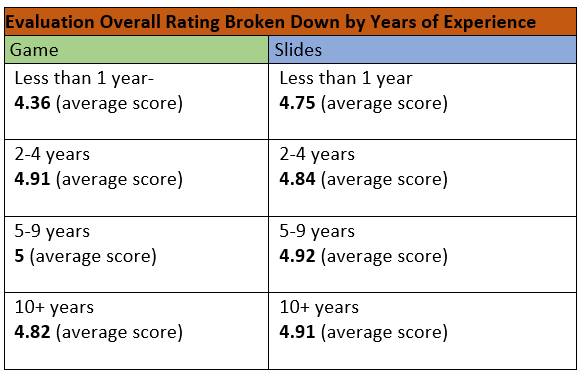
A pre-test, post-test, and evaluation were given to all nurses participating in the educational offering. The evaluation also included one demographic question asking, “How many years have you been a nurse?” Knowledge retention was assessed through a follow-up test administered in November 2025. The nurses who received the slides versus the game version of our sepsis content was randomized.
Lessons Learned
The post-test included a question of which modality the participant received. Some left this answer blank, while others did not complete the post-test at all. All of those were removed from final data collection. Leaving us with the results that are listed in the tables below.
Let’s Look at the Results
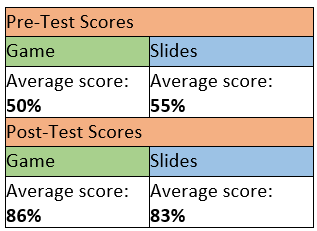
Pre-Test vs. Post-Test Results
Multiple choice question format for tests, with 77 game version participants and 72 slides version participants. Displayed is the percentage of staff that responded correctly to the test’s answers.
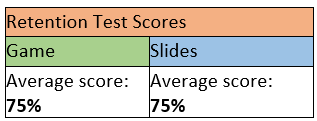
Retention Test Results
Same multiple choice question format for post-test, with 54 game version participants and 59 slides version participants. Displayed is the percentage of staff that responded correctly to the test’s answers.
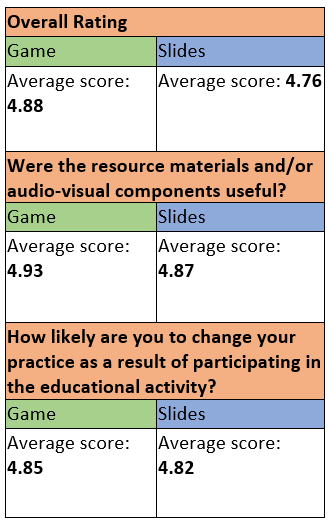
Evaluation Results
The evaluation utilized the Likert scale 1–5, with 1 being the worst and 5 being the best. There were 60 total responses for the game version and 67 for the slides version.
Conversations for the Future
A key lesson learned was that the game and slide stations should not have been conducted simultaneously. Many nurses naturally gravitated toward the same option as their friends or coworkers, which resulted in uneven participation between the two groups. Running both stations at the same time hindered the distribution of participants. It was distracting if paired with other learning events where the learner wouldn’t complete the test portions or evaluation. Certain groups did not have the skillsets to play the game as intended. Collection of knowledge retention was difficult to administer with varied times of administration of games and slides resulting in some testing months later and others a few weeks after. Our team will continue to evaluate and monitor feedback on the changes needed to our gaming elements. Future research is needed on the learning outcomes in medical gamification, as well as years of experience as a nurse and generational exposure to gamification.
Conclusion
Gamification is a newer format for education in the medical field that has shown positive impacts on the learner’s satisfaction and engagement with the educational content provided. Current research on the learner’s retention of the content and comparing gamification versus other methods of education is limited. In our study, we saw a trend showing overall improvement in the test results, retention in content, and increased satisfaction with the game version versus the slides version. While our game version did have overall better scores, both options showed an increase in the learner’s knowledge. Continued research and discussions need to be done going forward with this new promising educational option for the bedside nurse. Based on the results of this project, our team plans to continue exploring game-based learning opportunities and fine-tuning future educational offerings. Our final position is to “game on” going forward, while still using a multimodal educational format for the learner to increase their knowledge.
References
Joy, S., Rumsey, K., Ford, M., & Dickenson, V. (2023). Gamification: Development, challenges, and implications for undergraduate nursing education. Teaching and Learning in Nursing, 18(3), 423–425. https://doi.org/10.1016/j.teln.2023.04.004
Lee, C. Y., Lee, C. H., Lai, H. Y., Chen, P. J., Chen, M. M., & Yau, S. Y. (2025). Emerging trends in gamification for clinical reasoning education: A scoping review. BMC Medical Education, 25(1), Article 435. https://doi.org/10.1186/s12909-025-07044-7
Nylén-Eriksen, M., Stojiljkovic, M., Lillekroken, D., et al. (2025). Game-thinking: Utilizing serious games and gamification in nursing education: A systematic review and meta-analysis. BMC Medical Education, 25, Article 140. https://doi.org/10.1186/s12909-024-06531-7
Van Gaalen, A. E. J., Brouwer, J., Schönrock-Adema, J., Bouwkamp-Timmer, T., Jaarsma, A. D. C., & Georgiadis, J. R. (2021). Gamification of health professions education: A systematic review. Advances in Health Sciences Education, 26(2), 683–711. https://doi.org/10.1007/s10459-020-10000-3
Wang, Y. F., Hsu, Y. F., Fang, K. T., & Kuo, L. T. (2024). Gamification in medical education: Identifying and prioritizing key elements through Delphi method. Medical Education Online, 29(1), 2302231. https://doi.org/10.1080/10872981.2024.2302231
Laurel Butler, BSN, RN, RNC-NIC
Specialty Educator, Medical City Healthcare
Laurel Butler is a certified and bachelor's prepared nurse with 11 years of experience in the NICU. She has been a Medical City Healthcare specialty educator for three years. Prior to that, she was a bedside nurse, trained in care of the highest-acuity patients, including but not limited to total body cooling, extremely and very low birth weight infants, peritoneal dialysis, congenital cardiac disorders, neurologic disorders, and genetic disorders. She has been an ANN podium and poster presenter, discussing total body cooling and NICU advanced skills. She was a podium presenter at the AWHONN state conference, discussing total body cooling and HIE. She is a poster presenter on NICU Advanced skills for the 2026 NAAN National Convention. She also has received the D Magazine Excellence in Nursing Award.
Nichole Davis, MEd, BSN, RN, RNC-NIC
NICU Clinical Nurse Educator, Hospital Corporation of America
Nichole Davis is a certified and bachelor's prepared nurse with seven years of experience in the NICU setting and has a master's degree in education. She has been a NICU Clinical Nurse Educator since 2025. As a bedside nurse, she served as a primary preceptor and charge. She is an NRP instructor and class presenter for Neonatal Transition and Neonatal Assessment. Davis specializes in Golden Hour drills, PICC team education, OB in the ED classes, and NRP drills. She is a podium presenter for the AWHONN national convention on neonatal sepsis.

Caroline Day, BSN, RN, RNC-NIC
Division Clinical Professional Development Specialty Educator, Medical City Healthcare
Caroline Day is a dedicated neonatal intensive care unit (NICU) educator who has served in this role since April 2024. She brings nine years of hands-on experience as a NICU nurse, providing expert, compassionate care to critically ill and medically complex newborns and their families.
Throughout her career, Day has demonstrated a strong commitment to clinical excellence, professional development, and education. She served as a charge nurse (CNC) for two years, where she supported unit operations, mentored staff, and helped maintain high standards of patient care. As an educator, she is certified to teach Resolve Through Sharing, Neonatal Resuscitation Program (NRP), STABLE, and Cardiac STABLE, equipping healthcare professionals with essential skills for neonatal stabilization and family-centered care.
Day is recognized for her collaborative approach, strong leadership skills, and passion for fostering a supportive learning environment. Her combination of bedside expertise and educational leadership continues to positively impact NICU teams and the vulnerable infants they serve.
Ashley Duffield, BSN, RN, RNC-NIC
NICU Nurse Educator, Hospital Corporation of America
Ashley Duffield is a NICU nurse educator supporting a Level IV NICU with expertise in developing, delivering, and evaluating high-acuity neonatal education. She is an NRP and STABLE instructor for our division nurses. Duffield serves as a Nurse Planner for continuing education, designing accredited CE activities. She has helped to develop and teach Critical Drips, PPHN, and other neonatal division classes. She also serves in unit committees such as Unit Practice council and Golden Hour committee and is co-chair of the education division employee advisory group. Duffield has helped organize and develop the health system's annual NICU consortium for the past two years. She has presented posters for ANN and NANN national conventions.

Kayleigh Guillory
Clinical Education, Hospital Corporation of America
Kayleigh Guillory is a clinical educator for the neonatal, pediatric, and maternal populations. Kayleigh is a dedicated educator that is certified to teach STABLE, Cardiac STABLE, and Neonatal Resuscitation Program. She has served in this role since February 2024 and provides expertise to improve patient care and outcomes. Prior to her education role, Guillory served as a staff nurse in NICU and then transferred to a clinical nurse coordinator in well-baby nursery. She assisted in fostering a culture surrounding evidence-based practice and teamwork within her units.
Guillory consistently stands out for the way she leads with teamwork, professionalism, and compassion. She received the DAISY Award for Extraordinary Nurse Educators in 2024. She is dedicated to building a positive learning culture and supporting growth at every level. Her clinical expertise paired with her commitment to education continues to elevate the quality of care provided to our patients and their families.
Melissa Herman, MSN, RN, RNC-NIC
Clinical Education, Hospital Corporation of America
Melissa Herman is a certified and master's prepared nurse with 13 years of experience in the NICU. She has currently been in a HCA Clinical Education division role for five years. She is a DFW Great 100 Nurse and Extreme Nursing Award recipient. She has been an ANN national podium and poster presenter with specialized topics of total body cooling and NICU advanced skills. She is a podium presenter for AWHONN national convention in 2026 on neonatal sepsis. She is a poster presenter for upcoming 2026 NANN national convention on neonatal advanced skills. Her expertise lies with gamification, drills, and reverse classroom education techniques.